Emerging managers are held to institutional standards from day one
If you are raising Fund I or Fund II today, LPs will benchmark your operations against larger platforms:
- They expect professional fund accounting and capital account reporting.
- They expect coherent LP communications, data rooms, and cyber hygiene.
- They expect you to be able to answer questions about portfolio data and valuations with evidence, not anecdotes.
The good news: the market has never offered more purpose-built tools for VC and PE – from fund administration and investor portals to portfolio monitoring, CRM, and AI-enabled data platforms.
The challenge is not "can you find tools?" It is "can you assemble a stack that makes a two-person team look and operate like a much larger firm?"
Principles for an emerging-manager tech stack
Before listing tools, it helps to set a few principles.
1. Buy infrastructure, not toys
Focus on systems that:
- LPs recognize and trust (or at least understand).
- Reduce real operational risk (for example, capital account errors, missed notices).
- Make you more responsive to LP and portfolio needs.
This usually means prioritizing fund admin/fund accounting, investor reporting, and portfolio data infrastructure over exotic analytics in the early days.
2. Avoid tool sprawl
Most emerging managers do not need:
- Three different CRMs
- Two separate portfolio monitoring tools
- A half-dozen single-purpose "dashboards"
Pick one tool per core function and use it well. Sprawl creates more integration and data-consistency problems than it solves.
3. Design around data flows, not logos
Ask:
- Where does data originate (deals, companies, service providers)?
- How does it move through your stack?
- Where is the canonical source of truth at each level?
Your tech choices should support those flows, not the other way around.
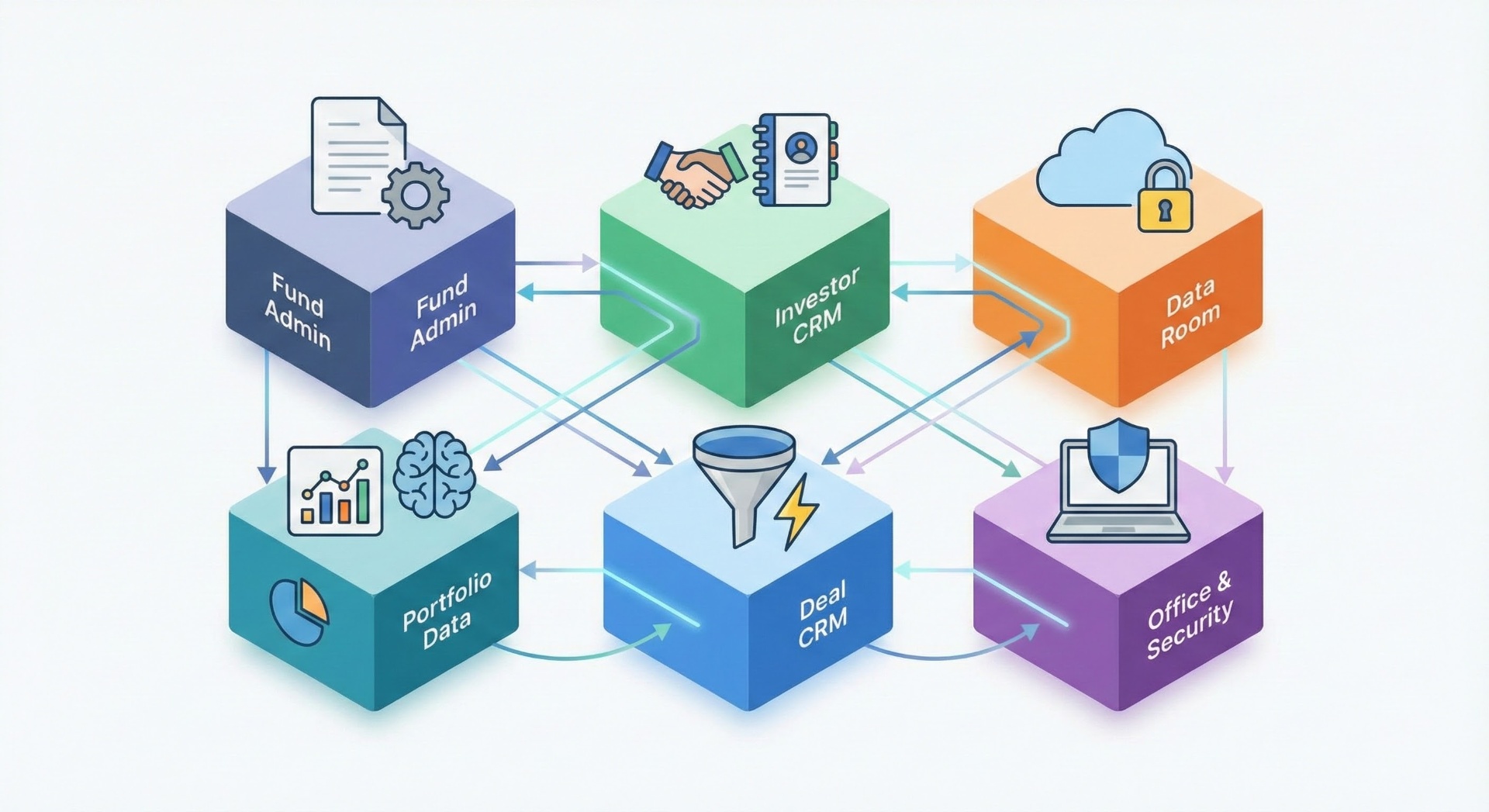
The core stack: six building blocks
Every emerging manager will make slightly different choices, but most institutional-grade stacks share six components.
1. Fund administration and accounting
Job: Maintain books and records, capital accounts, and official fund reporting.
Options include:
- Specialist fund administrators serving sub-$1B AUM managers.
- Platforms that bundle fund accounting with investor portals and waterfall engines.
What matters:
- Ability to support your structure (SPVs, co-invests, parallel vehicles).
- Responsiveness and quality of reporting.
- Openness to integrating with your other systems instead of trapping data.
2. Investor CRM and fundraising workspace
Job: Track relationships with LPs, fundraising pipelines, and interactions.
Tools range from:
- General CRMs with VC/PE overlays to
- Purpose-built fundraising CRMs aimed at emerging managers.
You want:
- Clean tracking of prospects, commitments, and key contacts.
- Integration (or at least clean export) to your data room and email tools.
- A way to capture Q&A and DDQ content for reuse.
3. Data room and LP portal
Job: Provide a secure, organized place for DDQs, PPMs, track records, and ongoing reporting.
Expectations:
- Granular permissioning (different views for prospects, current LPs, co-investors).
- Watermarking and logging of document access.
- Easy update workflows for quarterly reports and notices.
This can be via your fund admin's portal, a VDR provider, or a combined solution.
4. Portfolio data and monitoring
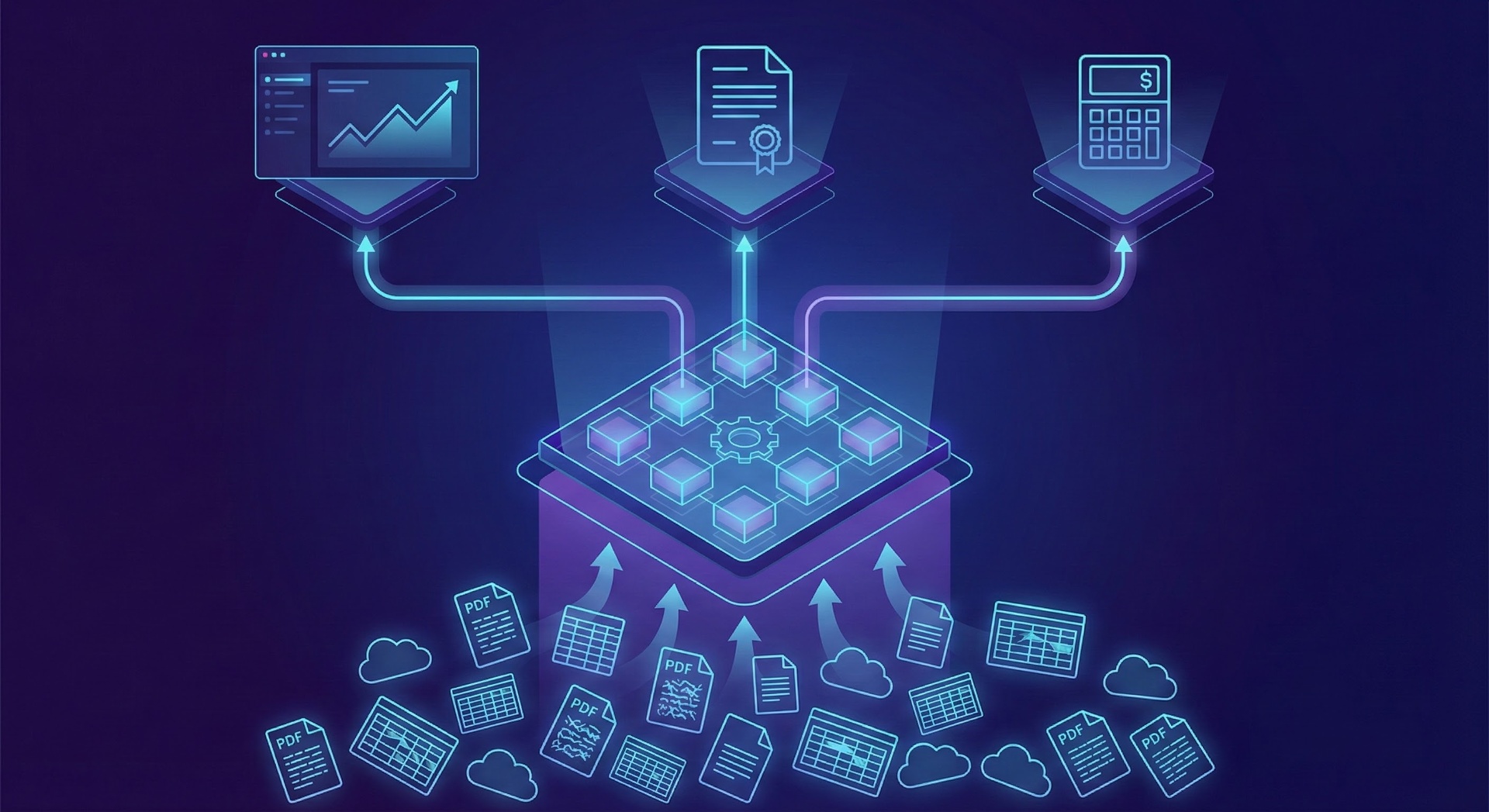
Job: Turn portfolio documents and company updates into structured data and usable insights.
Here is where an AI-first platform like GoodStream matters most for emerging managers:
- Automates ingestion of SPAs, notes, cap tables, financials, and KPI decks.
- Builds a structured portfolio data layer without you hiring a separate ops team.
- Enables credible portfolio monitoring, valuations, and LP responses from day one.
You want:
- Strong document linking and audit trails.
- Flexible metrics and tagging to match your strategy.
- Ability to support both early-stage VC metrics and later-stage or PE-style KPIs if you expand.
5. Deal flow and relationship intelligence
Job: Manage pipeline, notes, and relationships with founders, co-investors, and advisors.
Options:
- VC-specific CRMs that integrate deal pipelines, email, and meeting data.
At emerging-manager scale, pick one tool that:
- Lives where you and your partner actually work (email, calendar).
- Does not require a full-time admin to keep current.
- Can at least lightly integrate with the rest of your stack.
6. Office stack and security
Job: Enable day-to-day work and protect sensitive data.
You will need:
- Enterprise-grade email, document, and identity management (for example, Google Workspace or Microsoft 365 with SSO and MFA).
- A password manager and basic device management.
- Clear policies on how investor and portfolio data is handled.
For many LPs, seeing a thoughtful approach here is as important as which finance systems you use.
A sample stack for a two-person manager
To make this concrete, here is what a credible stack might look like for a sub-$200m Fund I:
- Fund admin / accounting: Specialist admin with an investor portal; quarterly financials and capital account statements.
- Investor CRM: A private-markets CRM tracking LP conversations, DDQ status, and allocations.
- Data room / portal: Admin portal or dedicated VDR for PPM, DDQ, legal docs, and quarterly reporting.
- Portfolio data platform: GoodStream as the Portfolio Brain, ingesting all portfolio docs and updates, feeding valuations and LP responses.
- Deal CRM: Relationship-centric CRM for deals and networks, lightly integrated with email/calendar.
- Core office & security: Workspace/365, MFA, password manager, and basic cyber policy.
All of that is manageable by two people with the right vendors and workflows.
How to talk about your stack with LPs
LPs do not need a tool-by-tool tour. They need confidence that:
- You have a coherent architecture, not a pile of point solutions.
- Critical processes (capital calls, valuations, reporting) have controls and clear system owners.
- You can scale the stack as AUM and complexity grow.
In practice, your narrative might sound like:
"We've designed our operations so that our fund admin is the source of truth for capital accounts and financials, GoodStream is the source of truth for portfolio data and documents, and our CRM and data room handle investor interactions. Everything else is in service of those pillars."
That feels institutional, even if the team is small.
A phased approach for emerging managers
You do not need to buy everything on day one.
Phase 1 – Pre-first close
- Lock in fund admin and basic office/cyber stack.
- Stand up investor CRM and a simple VDR for fundraising.
- Start using a portfolio data platform for your earliest deals so you are building history from the start.
Phase 2 – Post-first close, first year
- Formalize portfolio monitoring and reporting using your data platform plus admin outputs.
- Introduce valuation workflows with clear documentation.
- Tighten integrations between CRM, data room, and reporting.
Phase 3 – Scaling to Fund II
- Refine automation and AI use in portfolio data and reporting.
- Add more sophisticated analytics or dashboards as needed.
- Periodically review the stack with an LP mindset: does this look and feel institutional for the size of our platform?
The bar for "professional infrastructure" keeps rising, but the tools have never been more accessible. With a disciplined stack and strong processes, an emerging manager can credibly operate - and look - like a much larger firm.
Ready to see how GoodStream fits into your emerging manager tech stack? Book a demo and we will show you what institutional-grade portfolio data looks like from day one.