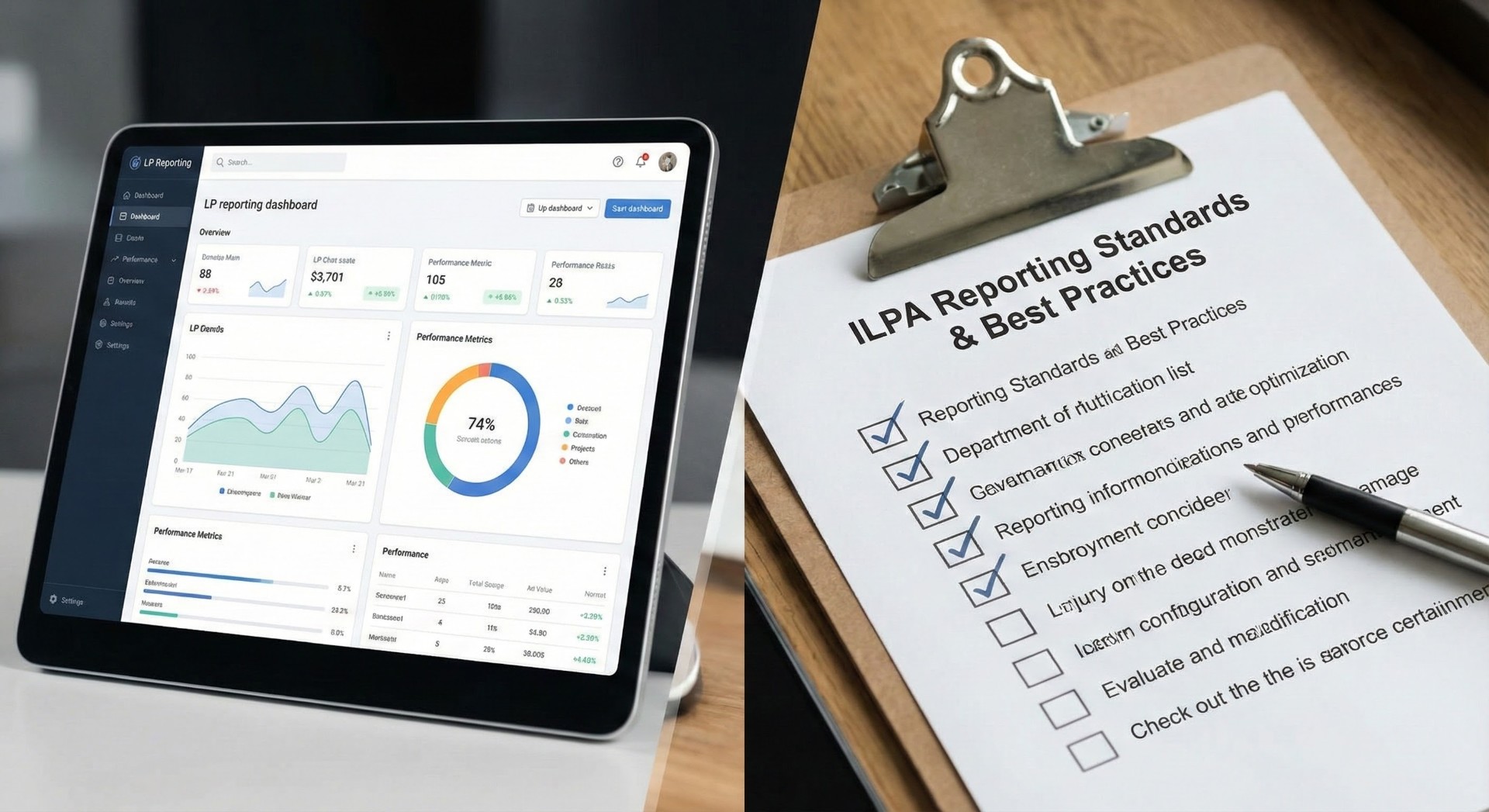
The LP reporting bar moved while many managers were busy
LP reporting expectations in 2025 are not what they were even a few years ago.
Large allocators and consultants are benchmarking managers against updated industry standards and their best peers, not against the weakest performers in their portfolio. At the same time, regulators have been explicit about deficiencies they keep finding in private fund reporting and disclosures.
That means two things for GPs:
- The floor is higher. Baseline compliance now includes structured, ILPA-style reporting and clear linkages between disclosures and actual practice.
- The differentiation bar is higher. LPs increasingly notice which managers can answer questions quickly, with evidence, and which ones cannot.
What sophisticated LPs actually care about
Across CIO, head-of-private-markets, and operations conversations, four themes tend to repeat:
1. Alignment with standards, not bespoke one-offs
The updated ILPA Reporting Template released in early 2025 is fast becoming the anchor for what "good" quarterly reporting looks like: clearer capital account roll-forwards, better fee and expense transparency, and structured performance and exposure data that can be fed into LP systems.
LPs do not want 12 different custom formats from 12 GPs if they can avoid it. They want enough standardization that they can compare across managers and strategies.
2. Consistency between documents, disclosures, and data
Regulatory risk alerts have repeatedly called out managers for:
- Failing to act consistently with written disclosures.
- Presenting performance in ways that cherry-pick data or misuse benchmarks.
- Applying fees and expenses in ways that do not match LPAs and side letters.
LPs are reading those same alerts. They know what examiners are looking for. They expect you to be ahead of that curve.
3. More frequent insight, not just quarterly PDFs
Quarterly is still the formal reporting cadence for most funds, but many LPs now expect:
- Interim NAV updates when markets move meaningfully.
- Faster notification of material events at portfolio companies.
- Periodic access to key KPIs, not just backward-looking financials.
They do not necessarily want weekly reports. They want to avoid surprises.
4. Evidence behind the marks
LPs are less interested in narrative "spin" and more interested in:
- Which valuation methodologies you used and why.
- How sensitive marks are to reasonable changes in assumptions.
- How those assumptions tie back to actual company performance and market data.
The days of "flat to last round because we say so" are numbered.
From quarterly scramble to continuous readiness
Many funds still treat each quarter as a mostly bespoke exercise:
- Rebuild the reporting pack.
- Re-key or clean data.
- Recreate the link between numbers and source documents.
- Re-argue valuation assumptions from scratch.
A continuous readiness model flips this:
- Documents and obligations are captured and tagged when they arrive, not at quarter end.
- Economic and reporting fields are extracted into a data model that is shared across valuations and LP reporting.
- Variances and issues are identified and resolved throughout the quarter.
- The reporting pack is largely an assembly job, not a forensic reconstruction.
In this model, the quarterly cycle becomes a controlled release of an always-on system, rather than a one-off project.
Practical best practices for 2025
If you want to move toward continuous readiness without rebuilding everything, focus on five concrete practices.
1. Put fund documents and LP obligations on rails
Create a single, controlled place where:
- LPAs, side letters, subscription docs, and key policies are stored and versioned.
- LP-specific obligations are tagged at the LP level.
- Economic terms and reporting obligations are extracted into structured fields.
Your reporting team should not need to re-read documents every time a question comes in.
2. Standardize your reporting template and mappings
Pick or adapt a standard template, such as the ILPA reporting formats, then:
- Map every field to a system data source.
- Identify which fields still require manual input and why.
- Eliminate "free text" where a structured field would be better.
This creates a blueprint for automation and for internal QA.
3. Tie valuations and reporting to the same data layer
Use the same underlying data for:
- Valuation models and memos.
- LP reports.
- Internal dashboards.
That way:
- When something changes in a company's metrics or capital structure, it cascades through the system.
- When you update a valuation assumption, you can see where it will show up in LP-visible materials.
- You can trace any reported number back to its origin.
4. Make anomalies visible early
Build simple guardrails that run throughout the quarter:
- Changes in key KPIs outside expected ranges.
- Unusual fee or expense allocations.
- New documents that introduce or modify LP-specific obligations.
The sooner you see an issue, the cheaper and less painful it is to fix.
5. Document your process like an exam is inevitable
Assume that at some point:
- An LP will ask you to walk through your reporting process in detail, or
- A regulator will expect you to show how you complied with your disclosures.
Having a written, living description of your reporting process, data flows, and controls is no longer optional. It is part of your license to operate.
What LPs notice when you get this right
When you build LP reporting on a robust data and process foundation, LPs experience you differently:
- Questions are answered in days, not weeks.
- Follow-up requests for "just one more cut" of the data become easier to handle.
- Examiners spend less time stuck on basic deficiencies and more time on constructive dialogue.
- Your team spends more time on forward-looking analysis and less time reconstructing history.
In a world where fundraising is more competitive and capital is consolidating with managers who demonstrate discipline and transparency, that difference matters.
If you want to see what continuous readiness looks like in practice, see our reporting features or book a demo.